
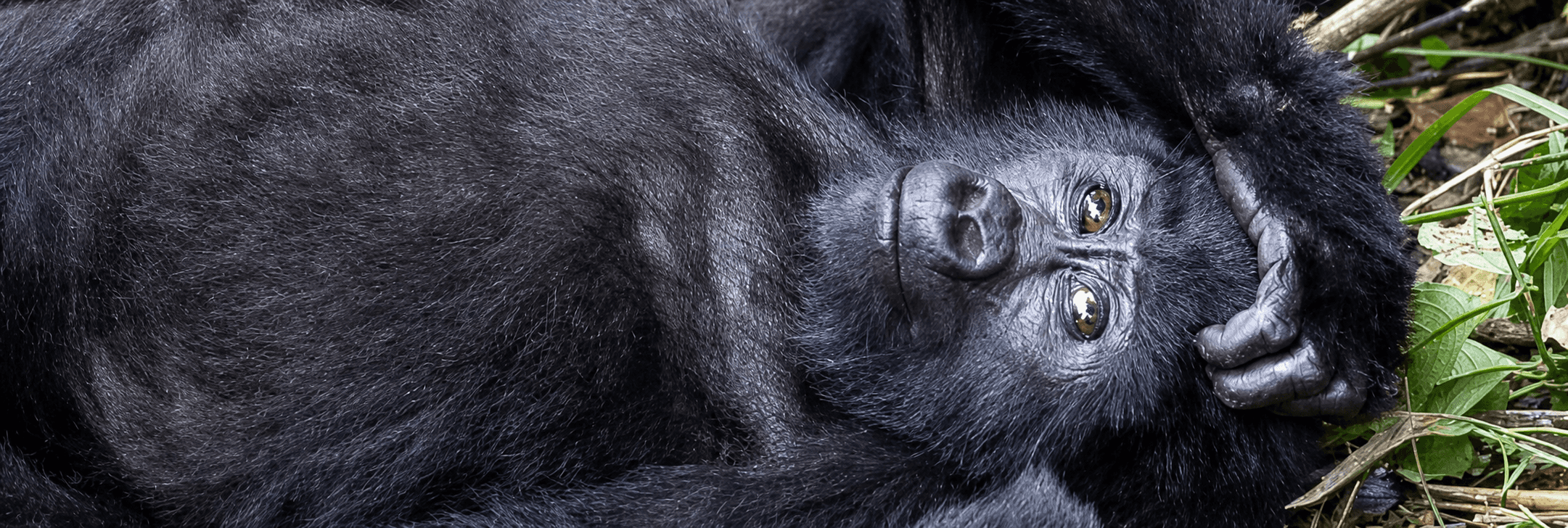
Mountain gorilla family resting in dense green vegetation

Wildlife profile

Mountain gorilla

The mountain gorilla is an Endangered great ape restricted to Bwindi and the Virunga massif. Regulated tracking can support conservation and local economies, but strict health, distance, time and group-size rules protect a small, disease-sensitive population.

At a glance

Scientific name
Gorilla beringei beringei
IUCN status
Endangered
Diet
Mostly leaves, stems, shoots and other plant material
Range
Bwindi and the Virunga massif

Field principle

  • Endangered; assessment trend increasing but conservation-dependent
  • Presence is not a sighting guarantee
  • Local rules govern vehicle position and distance
  • Global status is not the same as local abundance

How to identify it

Mountain gorillas have dense dark fur suited to cool highland forest. Mature males develop the silver-grey saddle that gives rise to the term silverback.

Behaviour and social life

Stable social groups are usually led and protected by a dominant silverback. Feeding, resting, grooming, play and travel structure the day.

Diet

Plant material dominates, though exact foods vary by site and season. Feeding often occurs in dense vegetation that can limit photography.

Habitat and East African context

Afromontane and bamboo forest across a very small range makes habitat protection and transboundary conservation vital.

Responsible viewing

A good encounter gives the animal control of distance and movement.

  • Do not trek when ill; human infections can threaten gorillas.
  • Respect the authority's current distance and viewing-time rules.
  • Never use flash or touch an animal, even if it approaches.

Photography considerations

Use technique and patience to protect the sighting rather than asking the guide to create an unnatural scene.

  • Set flash to disabled before the encounter.
  • Use higher ISO rather than forcing a slow shutter in forest shade.
  • Keep equipment compact and follow the ranger's position instructions.

Where you may encounter this species

rwanda

Volcanoes National Park

Volcanoes National Park protects montane habitat in north-west Rwanda and offers regulated mountain-gorilla tracking. Visits require an official permit, a briefing and ranger-led trek; a traveller must meet current age and health rules.

Read Volcanoes National Park

Approved package facts are preserved; wildlife remains an opportunity, never a guarantee.

Compare more routes

Related wildlife

Endangered

Chimpanzee

The chimpanzee is an Endangered, socially complex great ape of African forests and woodland mosaics. Uganda offers regulated chimpanzee tracking in selected sites; ecological presence in a forest does not automatically mean a visitor tracking programme exists there.

Read Chimpanzee

Common traveller questions

Is a gorilla sighting guaranteed?

Tracking teams work hard to locate habituated groups, but this remains a wild encounter and conditions vary. Official permit terms control the experience.

Why can illness prevent trekking?

Great apes are susceptible to human disease. Excluding an ill visitor is a conservation and animal-welfare measure.

Sources and fact checking

Facts checked: 2026-11-05

Official and conservation sources support the factual claims below. Time-sensitive fees, rules and conditions must be rechecked before travel.

  1. Guidelines for Gorilla and Chimpanzee Tracking — Uganda Wildlife Authority. Supports: minimum age, group size, viewing time, health, distance, no flash.
  2. Come Visit the Gorillas — Visit Rwanda / Rwanda Development Board. Supports: gorilla tracking rules, minimum age, health, distance, no flash.
  3. Mountain Gorilla Red List Assessment — IUCN Red List. Supports: taxonomy, Endangered status, range, population trend.

See our editorial standards and corrections policy.