
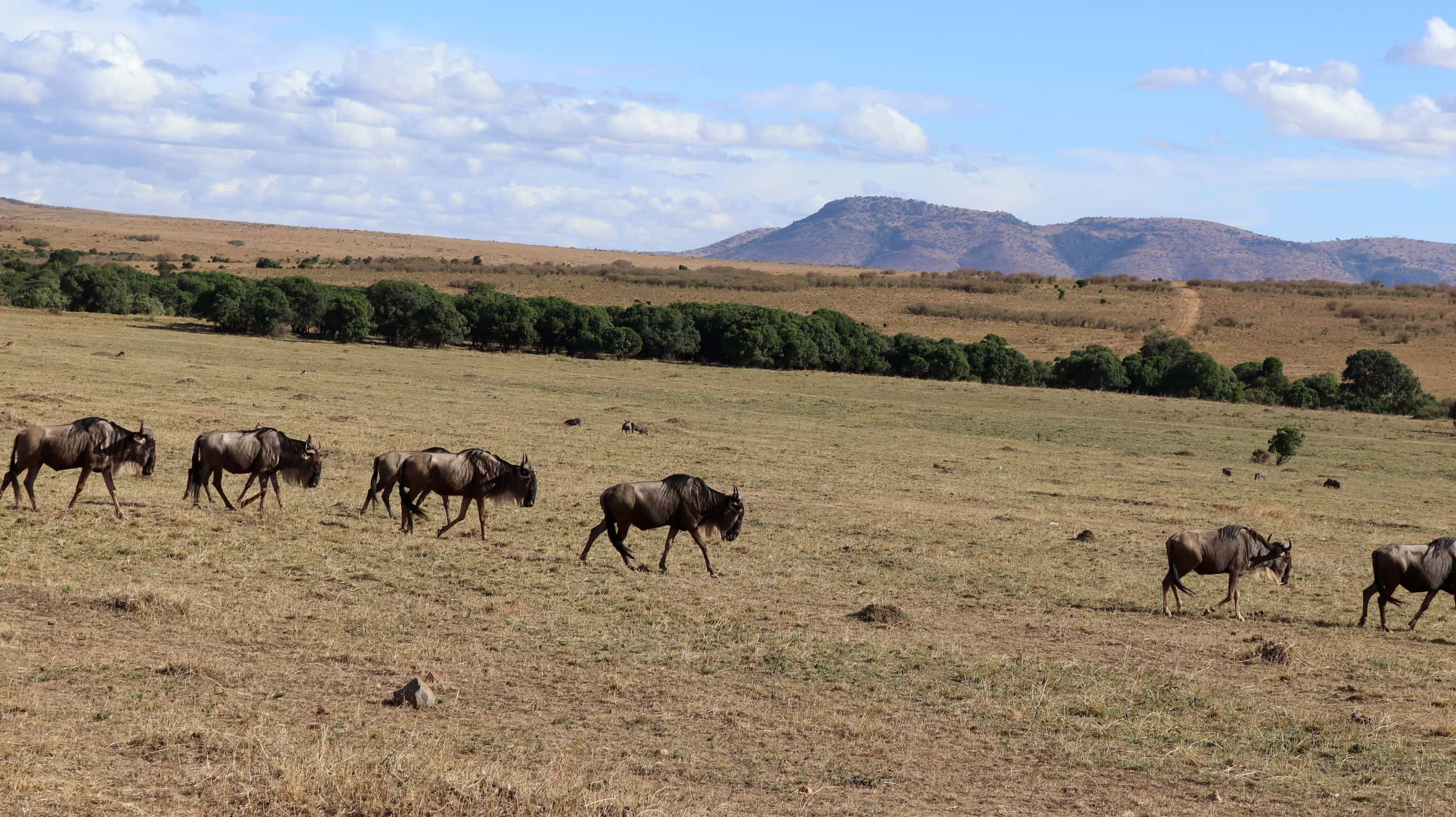
Common wildebeest entering a river during seasonal movement

Wildlife profile

Common wildebeest

The common or blue wildebeest is a herd-forming grazer. In the Mara-Serengeti ecosystem, very large herds move seasonally in response to rain, grazing and water; the movement is continuous and variable rather than a single event on fixed dates.

At a glance

Scientific name
Connochaetes taurinus
IUCN status
Least Concern
Diet
Grazer
Social pattern
Herds, including large seasonal aggregations

Field principle

  • Least Concern in the current global assessment; some migration corridors remain vulnerable
  • Presence is not a sighting guarantee
  • Local rules govern vehicle position and distance
  • Global status is not the same as local abundance

How to identify it

A sloping back, broad muzzle, curved horns and dark vertical body stripes distinguish the common wildebeest. Both sexes carry horns.

Behaviour and social life

Herds respond to fresh grazing, water and rainfall. Calving, rutting and long-distance movement occur within an ecosystem-scale cycle whose local timing changes.

Diet

Wildebeest favour grasses and often interact ecologically with zebra and other grazers that use different parts of the sward.

Habitat and East African context

Open grassland is central, but herds move through woodland, river approaches and mixed habitats. Protected corridors are important beyond park labels.

Responsible viewing

A good encounter gives the animal control of distance and movement.

  • Never pressure herds toward a riverbank.
  • Keep roads and crossing approaches clear.
  • Do not describe a traffic jam or distressed animal as entertainment.

Photography considerations

Use technique and patience to protect the sighting rather than asking the guide to create an unnatural scene.

  • A wider frame can communicate scale better than a close portrait.
  • Use fast shutter speeds for moving herds.
  • Expect dust and protect lenses during dry movement.

Where you may encounter this species

kenya

Masai Mara National Reserve

The Masai Mara is a savannah reserve in south-west Kenya, connected ecologically to Tanzania's Serengeti. Travellers choose it for year-round game viewing, big-cat habitat and seasonal movement of wildebeest and zebra, but no particular sighting or river crossing can be guaranteed.

Read Masai Mara National Reserve

kenya

Amboseli National Park

Amboseli is a southern Kenya national park known for elephants, wetlands fed by underground water and views toward Mount Kilimanjaro across the border in Tanzania. Clear mountain views depend on cloud and weather, so they should be treated as an opportunity rather than a promise.

Read Amboseli National Park

tanzania

Serengeti National Park

The Serengeti is a vast northern Tanzania national park within the wider Mara-Serengeti ecosystem. Wildlife viewing is possible year-round, while the location and pace of migratory herds change with rain, grazing and calving cycles.

Read Serengeti National Park

tanzania

Ngorongoro Conservation Area

The Ngorongoro Conservation Area is a multi-use protected landscape in northern Tanzania, best known to visitors for the Ngorongoro Crater. A crater game drive can offer concentrated wildlife viewing, while access, descent timing and current authority rules shape the day.

Read Ngorongoro Conservation Area

tanzania

Tarangire National Park

Tarangire is a northern Tanzania national park shaped by the Tarangire River, seasonal wetlands, woodland and baobabs. It is especially valued for elephant habitat and a landscape that contrasts with the Serengeti plains.

Read Tarangire National Park

Approved package facts are preserved; wildlife remains an opportunity, never a guarantee.

Compare more routes

Related wildlife

Vulnerable

African lion

The African lion is a social large cat of savannah, shrubland and woodland. East African parks can offer opportunities to observe prides or solitary animals, but activity, cover and territory make every sighting uncertain.

Read African lion

Vulnerable

Cheetah

The cheetah is a slender, speed-adapted cat associated with open grassland, savannah and shrubland. It is often active by day, but a safari cannot promise a chase or even a sighting.

Read Cheetah

Legacy subspecies assessment: Endangered

Masai giraffe

The Masai giraffe is an East African giraffe lineage now recognized as Giraffa tippelskirchi under the 2025 IUCN SSC taxonomy update. Its irregular, vine-like patches help distinguish it, but generic giraffe records should not be assigned to this species without evidence.

Read Masai giraffe

Common traveller questions

When is the Great Migration?

It is a year-round movement through the wider ecosystem. Likely locations change with rain and grazing; exact dates and crossings are not guaranteed.

Does Least Concern mean the migration is safe?

No. A global species category does not mean every population, corridor or seasonal movement is secure.

Sources and fact checking

Facts checked: 2026-11-05

Official and conservation sources support the factual claims below. Time-sensitive fees, rules and conditions must be rechecked before travel.

  1. Maasai Mara National Reserve Management Plan — County Government of Narok. Supports: reserve scope, habitats, wildlife and conservation context, Mara-Serengeti ecosystem.Note: Reserve, Mara Triangle, private conservancies and the wider ecosystem are kept as separate scopes.
  2. Serengeti National Park — Tanzania National Parks. Supports: park status, habitats, wildlife, migration variability.
  3. Common Wildebeest Red List Assessment — IUCN Red List. Supports: taxonomy, Least Concern status, herd and movement ecology.Note: An older global assessment; scheduled for periodic rechecking and never used to imply corridors are secure.

See our editorial standards and corrections policy.