
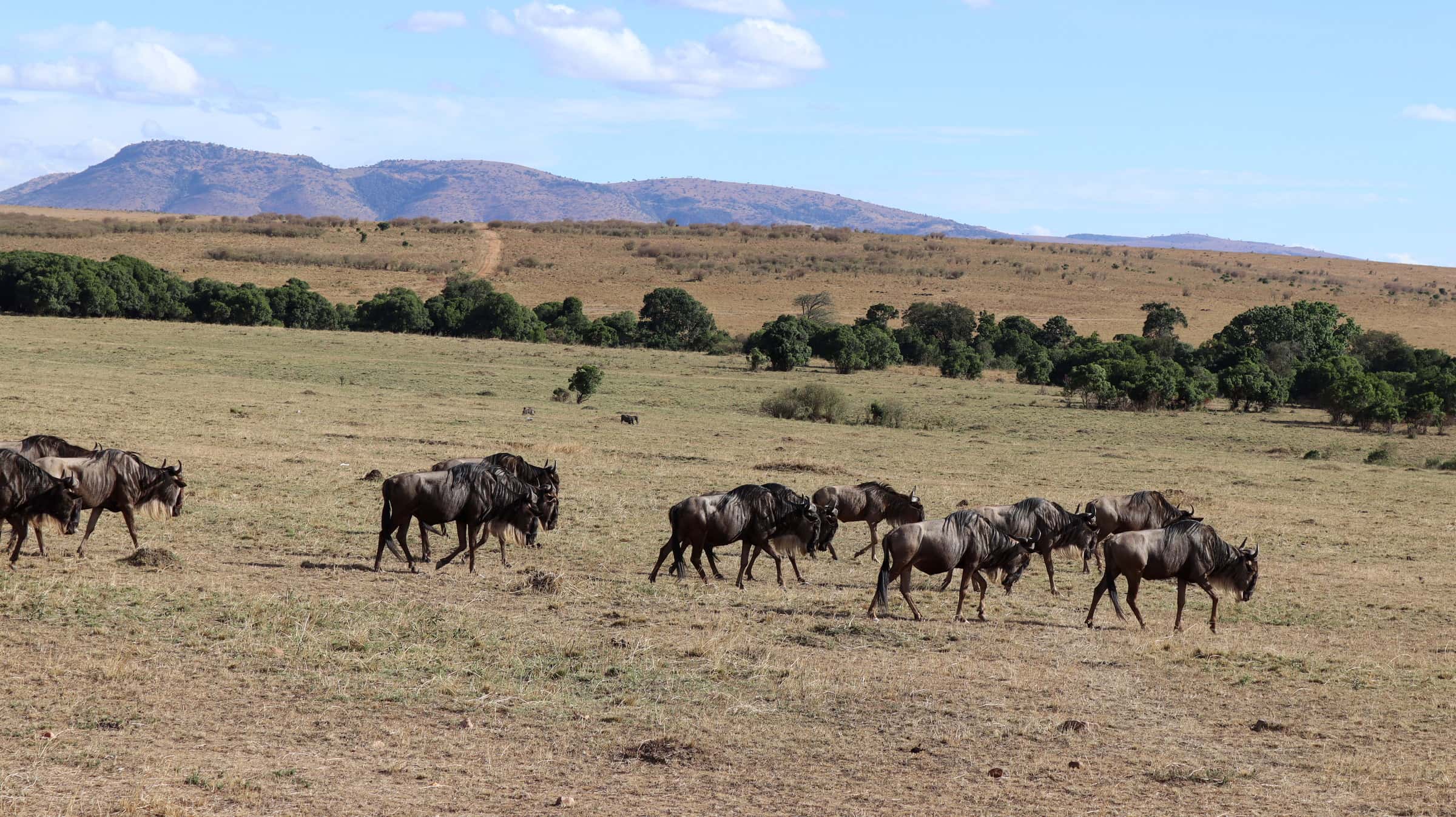
Wildebeest crossing a river in the Mara-Serengeti ecosystem

Kenya destination guide

Masai Mara National Reserve

The Masai Mara is a savannah reserve in south-west Kenya, connected ecologically to Tanzania's Serengeti. Travellers choose it for year-round game viewing, big-cat habitat and seasonal movement of wildebeest and zebra, but no particular sighting or river crossing can be guaranteed.

At a glance

Country
Kenya
Landscape
Open grassland, riverine woodland and seasonal streams
Known for
Big cats, grazing herds and the wider Mara-Serengeti migration
Common route
Nairobi, Lake Nakuru or Lake Naivasha to the Mara

Why it matters

  • Game drives across open savannah and river systems
  • Wildlife viewing that is rewarding outside migration months too
  • A broad choice of camps, lodges and conservancy-based stays
  • Useful pairing with Lake Nakuru, Lake Naivasha or the Serengeti

Why travellers choose the Masai Mara

Open plains make many animals easier to observe than they are in dense woodland. Lions, elephants, buffalo, giraffes, zebras, wildebeest and several antelope species use the wider ecosystem, while leopards and cheetahs require patient, respectful searching.

Migration coverage can make the reserve appear seasonal, yet resident wildlife remains throughout the year. Rainfall influences grass, water, road conditions and herd movement, so the best month depends on whether your priority is migration activity, quieter travel, green landscapes, photography or budget.

Planning the route and stay

The Mara is commonly reached by road from Nairobi or linked after Rift Valley stops. A flight can reduce road time but introduces carrier-specific baggage rules. Your quote should state whether the stay is inside the reserve, near a gate or in a conservancy, because the setting can change transfer time, permitted activities and the rhythm of game drives.

Lodge, permanent tented camp and simpler camp labels describe broad styles rather than a universal quality standard. Compare the exact property, bathroom arrangement, power schedule, family configuration, meal plan and game-drive arrangement before booking.

Responsible viewing and photography

Wildlife has right of way. A good sighting should not depend on crowding an animal, blocking its route or pressuring it for a photograph. Reserve rules and guide directions take priority, and off-road access varies by zone and land-management arrangement.

Bring a longer lens rather than expecting the vehicle to approach too closely. Early and late light can be excellent, but animal welfare, road rules and safe spacing matter more than recreating a particular photograph.

Wildlife you may encounter

Vulnerable

African lion

The African lion is a social large cat of savannah, shrubland and woodland. East African parks can offer opportunities to observe prides or solitary animals, but activity, cover and territory make every sighting uncertain.

Read African lion

Endangered

African savanna elephant

The African savanna elephant is a wide-ranging, highly social herbivore of open and wooded habitats. Family groups and bulls move across park boundaries and wildlife corridors, so their space and right of way are central to responsible viewing.

Read African savanna elephant

Vulnerable

African leopard

The African leopard is a solitary, adaptable spotted cat that uses savannah, woodland, rocky country and forest. It can live near busy safari routes yet remain difficult to find because camouflage and cover are central to its behaviour.

Read African leopard

Vulnerable

Cheetah

The cheetah is a slender, speed-adapted cat associated with open grassland, savannah and shrubland. It is often active by day, but a safari cannot promise a chase or even a sighting.

Read Cheetah

Critically Endangered (IUCN assessment)

Black rhinoceros

The black rhinoceros is a Critically Endangered browsing rhino with a hooked upper lip. East African populations are closely protected; exact locations should not be exposed and a safari should never promise a sighting.

Read Black rhinoceros

Near Threatened

African buffalo

The African buffalo is a water-dependent, herd-forming bovid found in grassland, woodland and some forest systems. It is powerful and unpredictable at close range, so visitors should remain in authorized vehicles or guided areas.

Read African buffalo

Legacy subspecies assessment: Endangered

Masai giraffe

The Masai giraffe is an East African giraffe lineage now recognized as Giraffa tippelskirchi under the 2025 IUCN SSC taxonomy update. Its irregular, vine-like patches help distinguish it, but generic giraffe records should not be assigned to this species without evidence.

Read Masai giraffe

Least Concern in the current global assessment

Common wildebeest

The common or blue wildebeest is a herd-forming grazer. In the Mara-Serengeti ecosystem, very large herds move seasonally in response to rain, grazing and water; the movement is continuous and variable rather than a single event on fixed dates.

Read Common wildebeest

Accommodation to discuss during planning

Planning option — not automatic inclusion

Miti Mingi Eco Camp

Miti Mingi Eco Camp is presented as a possible Masai Mara-area planning option, not as an automatic inclusion in a Safaris Adventure Bookers itinerary. The authorized photographs show simple permanent structures, guest bedrooms with mosquito nets, en-suite bathroom space and a shared dining room; current services and allocation must be confirmed in writing.

Read Miti Mingi Eco Camp

Approved package facts are preserved; wildlife remains an opportunity, never a guarantee.

Compare more routes

Planning guides

Travel guide

Kenya vs Tanzania Safari

Choose Kenya when you value a compact range of routes, Nairobi access and combinations such as the Masai Mara with Rift Valley or coast. Choose northern Tanzania when you want a broad Serengeti-Ngorongoro-Tarangire circuit. Choose both only when you have enough nights for border or flight logistics; neither country is a universal winner.

Read Kenya vs Tanzania Safari

Travel guide

Best Time for an East Africa Safari

There is no single best month for all East Africa. Drier periods can concentrate some wildlife and improve road conditions; greener periods can bring birding, dramatic landscapes and lower demand. Migration, rain and gorilla trekking require destination-specific planning, not a fixed continent-wide calendar.

Read Best Time for an East Africa Safari

Travel guide

Safari Accommodation Explained

Choose safari accommodation by exact property, location, room and operating details, not by the word lodge, camp or luxury alone. A permanent tented camp can have full en-suite rooms, while a lodge can be simple; category labels are not universal ratings.

Read Safari Accommodation Explained

More Kenya destinations

Amboseli National Park

Amboseli is a southern Kenya national park known for elephants, wetlands fed by underground water and views toward Mount Kilimanjaro across the border in Tanzania. Clear mountain views depend on cloud and weather, so they should be treated as an opportunity rather than a promise.

Read Amboseli National Park

Lake Nakuru National Park

Lake Nakuru National Park protects a Rift Valley lake and surrounding woodland, grassland and rocky escarpment. It is frequently included for rhino conservation and birdlife; flamingo numbers change with lake conditions and should never be promised.

Read Lake Nakuru National Park

Lake Naivasha

Lake Naivasha is a freshwater Rift Valley lake used as a relaxed stop between Nairobi, Lake Nakuru and the Masai Mara. Boat trips, birding and nearby walking or cycling activities are optional and depend on weather, water conditions and the chosen operator.

Read Lake Naivasha

Common traveller questions

Is the Great Migration always in the Masai Mara?

No. The herds move through a large Kenya-Tanzania ecosystem in response to rainfall and grazing. Timing varies, and a river crossing cannot be scheduled or guaranteed.

How many nights work well in the Mara?

Two to four nights are common, but the right stay depends on the wider route, road or flight logistics and how much unhurried game-viewing time you want.

Can children visit the Masai Mara?

Yes, but vehicle time, child policies, room configuration and an unfenced camp setting need to be considered for the youngest traveller.

Sources and fact checking

Facts checked: 2026-11-05

Official and conservation sources support the factual claims below. Time-sensitive fees, rules and conditions must be rechecked before travel.

  1. Maasai Mara National Reserve Management Plan — County Government of Narok. Supports: reserve scope, habitats, wildlife and conservation context, Mara-Serengeti ecosystem.Note: Reserve, Mara Triangle, private conservancies and the wider ecosystem are kept as separate scopes.
  2. Kenya Wildlife Service Park Rules — Kenya Wildlife Service. Supports: wildlife right of way, vehicle and visitor conduct, feeding and noise restrictions.Note: Applied to KWS-managed areas only; reserve and private-land rules can differ.
  3. Climate Services and Seasonal Forecasts — Kenya Meteorological Department. Supports: climate-planning method, need to check current seasonal forecasts.

See our editorial standards and corrections policy.

Prepared by the Safaris Adventure Bookers travel editorial team. No wildlife sighting is guaranteed.